

Is MSG the ingredient people blame for headaches, or the tiny trick chefs use to make food taste richer?
Monosodium glutamate is simply the sodium form of glutamate, an amino acid your body and common foods already have, and it boosts savory, meaty notes without just adding salt.
This post will zoom in on what MSG actually does, how it’s made, where it shows up on labels, who might notice effects, and simple, practical moves for cooking and buying smarter.
Understanding MSG as a Food Additive and What It Does in Your Food

Monosodium glutamate is the sodium salt of L‑glutamic acid, an amino acid your body already makes and one that shows up in tons of everyday foods. Back in 1908, a Japanese chemist named Kikunae Ikeda pulled glutamate out of seaweed broth and turned it into the first commercial MSG powder. He noticed it delivered a savory taste he called umami. Instead of making food taste saltier, MSG made it taste richer, meatier, more satisfying.
MSG looks like table salt or sugar. White, odorless, crystalline. It’s a flavor booster, not really a flavor on its own. On your tongue, plain MSG tastes like almost nothing. But when you add it to soup, sauce, or a stir-fry, it wakes up the savory notes by hitting specific taste receptors. You get more depth with less powder than you’d expect.
Glutamate isn’t some lab-only invention. Your body produces it. Your taste buds recognize it. Whole foods contain high concentrations naturally. When you eat a tomato, mushroom, or chunk of aged cheese, you’re eating free glutamate in its natural form. The difference between natural glutamate and the monosodium version is packaging and concentration, not chemistry.
Natural foods rich in glutamate include:
- Tomatoes and tomato paste
- Parmesan cheese
- Dried shiitake mushrooms
- Anchovies and other fermented fish products
- Soy sauce and miso
How MSG Works to Enhance Umami Flavor in Cooking

When MSG dissolves on your tongue, it releases free glutamate ions. Those ions bind to specific umami receptors on taste cells. The receptors fire signals to your brain that register savory flavor, the same signals you get from aged cheese, ripe tomatoes, or slow-cooked meat. MSG doesn’t introduce a new taste. It activates the fifth basic taste receptor, right alongside sweet, sour, salty, and bitter.
Umami makes food feel fuller and more satisfying. It helps other flavors blend and creates a rounded, cohesive taste profile. MSG is self-limiting. If you add too much, the dish tastes muddy or flat, which is why recipes call for small amounts. Use MSG like you would salt. A pinch is powerful, a tablespoon is a mistake.
How MSG activates umami receptors:
- MSG dissolves in saliva and releases free glutamate ions.
- Glutamate ions bind to T1R1 and T1R3 taste receptors on the tongue.
- Receptors send electrical signals through nerves to the brain’s taste centers.
- The brain interprets these signals as savory, meaty, or umami flavor.
A typical home-cooking dose is about 1/4 to 1/2 teaspoon per pound of meat, enough to season a dish that serves four to six people. That small amount deepens flavor without overwhelming the palate or leaving a chemical aftertaste.
How Monosodium Glutamate Is Made and Why It’s Used in the Food Industry

Industrial MSG production relies on microbial fermentation, a process similar to making yogurt, vinegar, or soy sauce. Manufacturers start with a carbohydrate source like starch, sugar beets, sugar cane, or molasses. Specific bacteria, often strains of Corynebacterium glutamicum, eat the sugar and excrete glutamic acid. The glutamic acid gets neutralized with sodium hydroxide or sodium carbonate, crystallized, dried, and sieved into a fine white powder.
This fermentation method replaced the original seaweed-extraction process decades ago. It now supplies the global market efficiently and at scale. The final product is chemically identical to the glutamate in tomatoes or Parmesan. On ingredient labels, MSG appears as “monosodium glutamate” in the United States or “E621” in the European Union and other regions using the E‑number additive system.
Food manufacturers use MSG to boost palatability in products where flavor would otherwise be weak or flat. It lets companies reduce salt, fat, or expensive ingredients like meat or cheese while keeping consumer appeal. MSG also balances bitterness in canned vegetables, intensifies broth flavor in soups, and extends the savory profile in snack seasonings and frozen dinners.
| Production Input | Fermentation Output |
|---|---|
| Sugar beets or sugar cane | Glutamic acid via bacterial fermentation |
| Starch or molasses | Glutamic acid neutralized with sodium to form MSG |
| Corynebacterium glutamicum bacteria | White crystalline monosodium glutamate powder |
Common Foods That Contain MSG or Naturally Occurring Glutamates
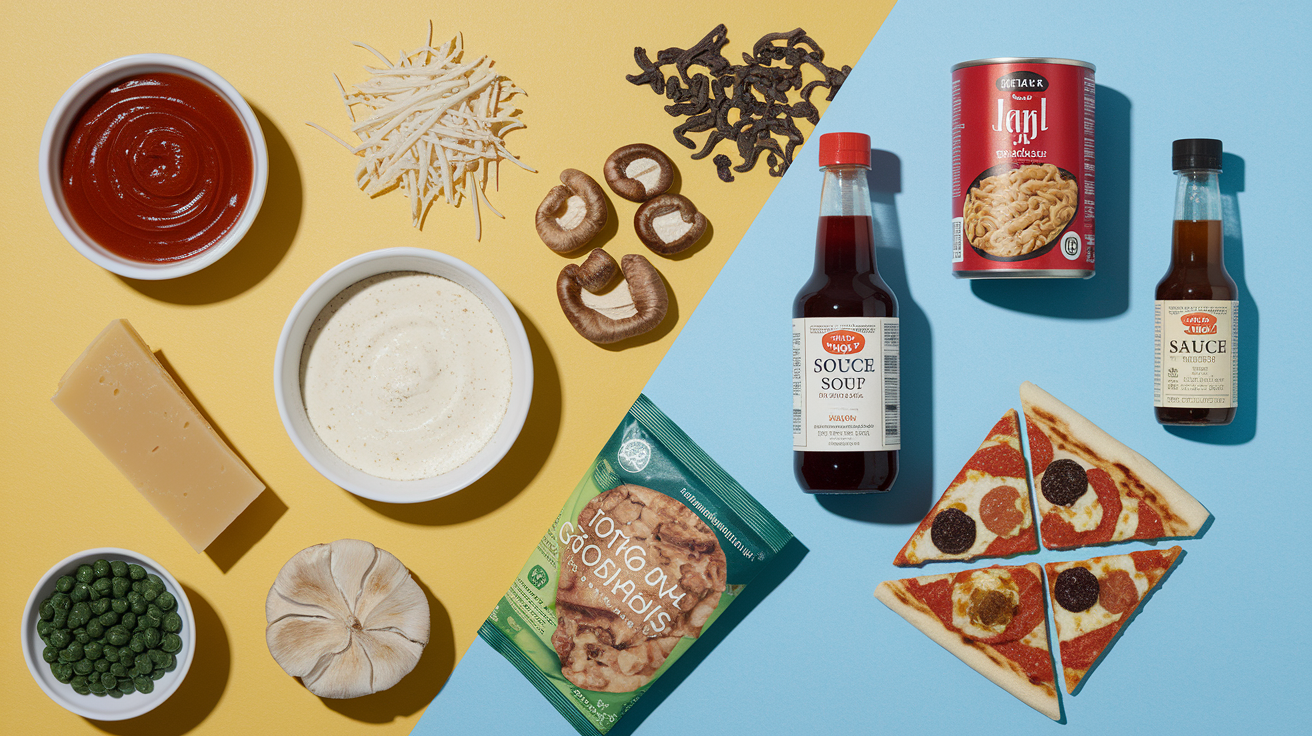
MSG shows up in two broad categories. Foods that naturally contain glutamate and processed products where manufacturers add monosodium glutamate during production. In the first group, glutamate forms during ripening, fermentation, or aging. Tomato paste concentrates glutamate as water evaporates. Parmesan develops free glutamate as enzymes break down milk proteins over months. Dried shiitake mushrooms, oysters, clams, and egg yolks all deliver umami without a label disclosure because the glutamate occurs naturally.
In the second group, food companies add MSG to boost flavor in convenience products. Canned soups, bouillon cubes, seasoning blends, instant noodles, frozen pizzas, and packaged mac-and-cheese dinners frequently list monosodium glutamate on the ingredient panel. Salad dressings, ketchup, barbecue sauce, and mayonnaise sometimes include it to round out tangy or sweet notes. Many deli meats, hot dogs, beef jerky, sausages, and smoked meats use MSG to amp up savory flavor and extend shelf appeal.
Fast-food and restaurant kitchens also rely on MSG in marinades, fry seasonings, and sauces. Recipes are often proprietary, but certain fried-chicken chains and Asian take-out staples like fried rice openly use MSG to deliver consistent umami across thousands of locations. Snack-food aisles are another common source. Flavored potato chips, cheese puffs, and seasoned crackers often contain MSG to amplify savory coatings and keep consumers reaching for another handful.
Eight food categories that commonly contain added MSG:
- Fast food (fried chicken, chicken sandwiches, fried rice)
- Chips and flavored snack foods (potato chips, cheese crisps)
- Seasoning blends and bouillon cubes (taco seasoning, chicken bouillon, stir‑fry mixes)
- Frozen meals (frozen dinners, frozen pizzas, mac‑and‑cheese, breakfast skillets)
- Soups (canned chicken noodle, dried soup mixes)
- Processed meats (hot dogs, lunch meats, beef jerky, pepperoni, meat snack sticks)
- Condiments (some salad dressings, mayonnaise, ketchup, barbecue sauces, soy sauce)
- Instant noodle products (ramen flavor packets, cup noodles)
Safety Research, Regulatory Stance, and What Studies Say About MSG in Food

In the 1990s, multiple regulatory agencies conducted comprehensive reviews of MSG safety. The United States Food and Drug Administration classified monosodium glutamate as Generally Recognized As Safe (GRAS) for use in food at typical levels. The Joint Expert Committee on Food Additives (JECFA), a scientific advisory body to the World Health Organization and the Food and Agriculture Organization, reviewed decades of toxicology data and didn’t establish an Acceptable Daily Intake (ADI). They concluded that no hazard was identified at normal dietary consumption levels.
The European Food Safety Authority took a more conservative stance and set an ADI of 30 milligrams per kilogram of body weight per day. For a 150-pound adult, that threshold equals roughly 2 grams of MSG daily. Average consumption estimates suggest most people fall well below that limit. Studies in the United States and United Kingdom report mean intakes around 0.55 grams per day. Surveys in certain Asian countries where MSG use is more common estimate daily intake between 1.2 and 1.7 grams.
Most adverse-effect reports involve doses of 3 grams or more consumed at one time without food. Reaching 3 grams in a single meal is uncommon with typical portion sizes. A half-teaspoon of MSG weighs about 2.5 grams, so hitting that threshold would require eating a large serving of a heavily seasoned dish or consuming MSG directly, which rarely happens in real-world cooking or dining.
A review of 40 studies examining MSG and health outcomes found that most research linking the additive to negative effects was low quality and suffered from methodological flaws. Controlled human trials with blinding and placebo groups have generally failed to reproduce consistent symptoms when MSG is given in amounts comparable to normal dietary exposure. Animal studies have shown associations between high-dose MSG and obesity, liver damage, and metabolic dysfunction, but those doses often far exceed what humans consume and don’t account for differences in metabolism and diet context.
Common findings from controlled MSG studies:
- Symptoms are rare at doses below 3 grams per meal when consumed with food.
- Self-reported sensitivity isn’t reliably reproduced in blinded, placebo-controlled trials.
- Long-term population studies show mixed results and can’t isolate MSG from overall diet quality.
Reported Symptoms, Sensitivity Rates, and “Chinese Restaurant Syndrome” Myths
Fewer than 1% of the general population report consistent sensitivity to MSG. Reported symptoms include headache, skin flushing, sweating, nausea, numbness or tingling, and fatigue. These reactions are typically mild, short-lived, and occur when large amounts are consumed on an empty stomach. Serious allergic reactions to MSG are rare and not well documented in peer-reviewed literature.
The term “Chinese restaurant syndrome” originated from a 1968 letter published in a major medical journal. The author described transient symptoms after eating at Chinese restaurants and speculated about MSG as a possible cause. The letter was anecdotal, not a research study, but it sparked decades of concern and shaped public perception. Subsequent blinded trials struggled to confirm a direct causal link between MSG and the symptom cluster described in that letter. What started as one person’s dinner complaint became a lasting myth that scientific evidence has never fully supported.
When Symptoms Occur
Symptoms attributed to MSG usually begin within two hours of consumption. The trigger dose cited in research is typically 3 grams or more taken without food, a scenario more common in laboratory settings than in home kitchens or restaurants. When MSG is mixed into a meal with protein, fat, and fiber, absorption slows and the likelihood of a reaction drops.
Current evidence doesn’t support the idea that MSG causes widespread or severe health problems in the general population. People who suspect they react to MSG should track their intake, test their response in controlled conditions, and consult a healthcare provider if symptoms are frequent or disruptive. Many reported reactions may stem from other ingredients in the same foods, such as high sodium, histamine-rich components, or allergens unrelated to glutamate.
Sodium Content of MSG vs. Salt and How It Can Reduce Sodium in Meals
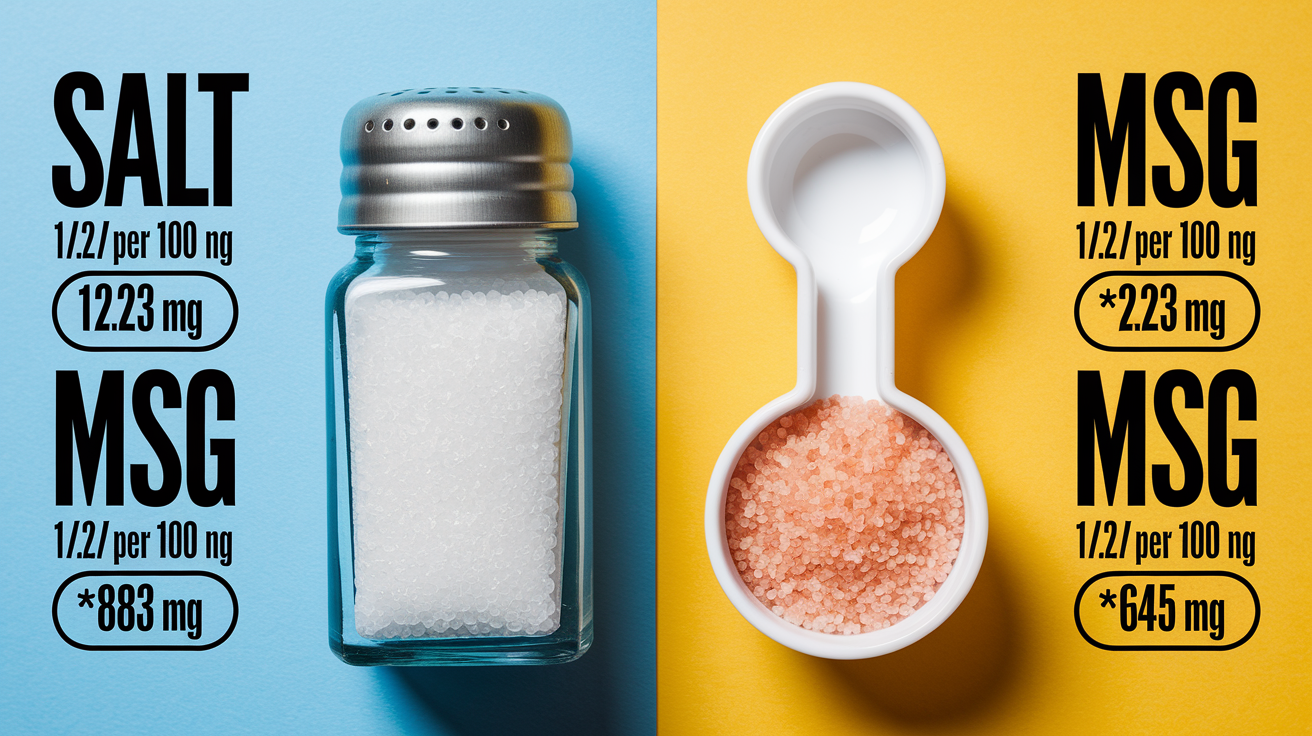
Monosodium glutamate contains about 12.28 grams of sodium per 100 grams of powder. Table salt contains roughly 39.34 grams of sodium per 100 grams. That means MSG delivers approximately two-thirds less sodium by weight while still boosting savory flavor. Replacing half a teaspoon of table salt with half a teaspoon of MSG in a recipe can reduce the sodium content of that dish by about 37% without sacrificing taste.
This swap is most effective in soups, stews, marinades, and seasoning blends where umami can fill the flavor gap left by reduced salt. A 50/50 blend of salt and MSG gives a middle ground, cutting sodium while preserving the salty taste many people expect. The key is to start with small substitutions and adjust to your palate, since MSG doesn’t replicate the sharp, clean salinity of pure sodium chloride.
For people managing blood pressure or following a low-sodium diet, using MSG strategically can make unsalted or low-salt dishes more appealing. It won’t eliminate sodium entirely, but it offers a practical tool to lower intake without turning meals bland. Pairing MSG with other umami-rich ingredients like mushrooms, tomato paste, or Parmesan further amplifies savory flavor and reduces reliance on added salt.
| Ingredient | Sodium per 100 g | Sodium per 1/2 teaspoon (approx. 2.5 g) |
|---|---|---|
| Table Salt | 39.34 g | ~983 mg |
| MSG | 12.28 g | ~307 mg |
| 50/50 Salt‑MSG Blend | ~25.81 g | ~645 mg |
How to Read Food Labels for MSG and Hidden Sources of Added Glutamates
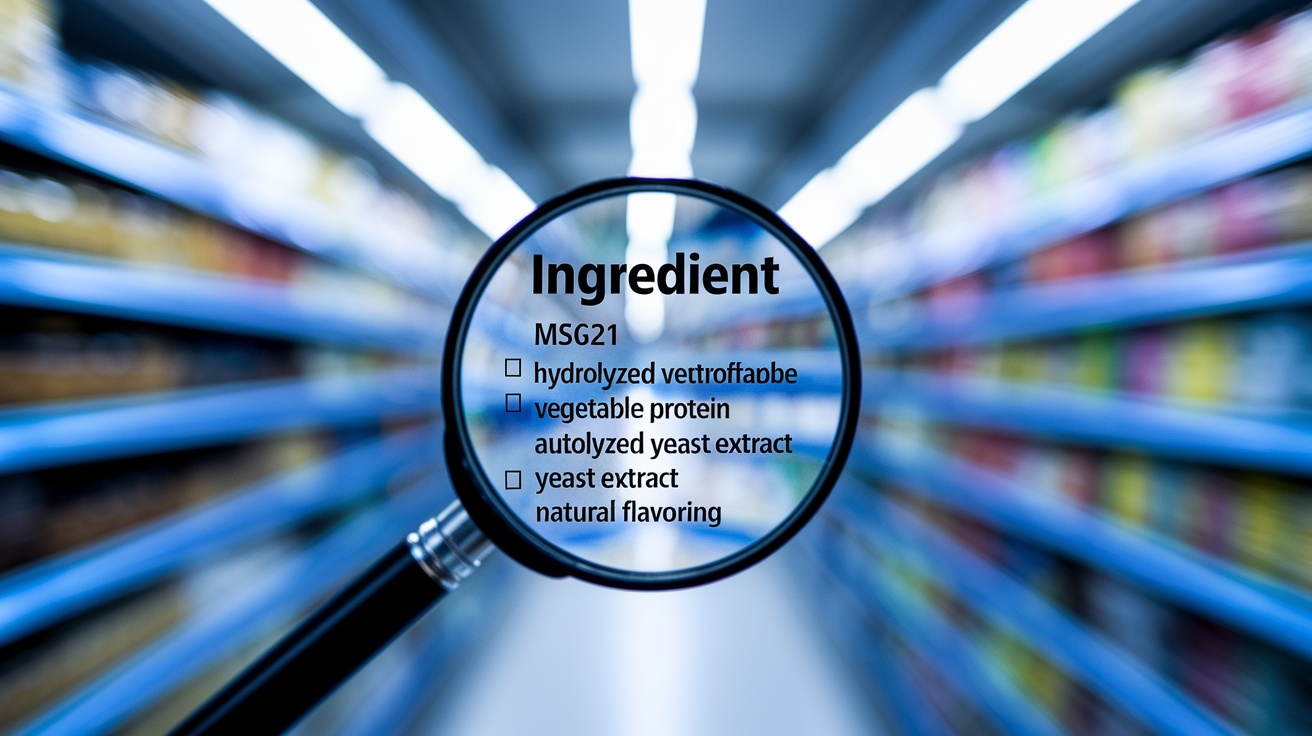
When monosodium glutamate is added to a product, United States regulations require it to appear by name on the ingredient list. In European markets and other regions using the E‑number system, it may be listed as E621. Either way, the label must disclose its presence if the manufacturer intentionally adds MSG during processing.
The challenge comes with ingredients that naturally contain free glutamate or with hydrolyzed proteins and yeast extracts that release glutamate during production. Terms like “hydrolyzed vegetable protein,” “autolyzed yeast extract,” “yeast extract,” “soy protein isolate,” and generic “natural flavoring” can all signal the presence of free glutamates, even when “monosodium glutamate” doesn’t appear. These ingredients aren’t required to carry an MSG warning because the glutamate forms as part of the ingredient itself, not as a separate additive.
Foods labeled “contains naturally occurring glutamates” refer to whole-food sources like tomatoes, cheeses, or mushrooms. These products don’t require MSG disclosure because the glutamate is intrinsic to the food, not added. If you want to avoid all sources of free glutamate, that becomes nearly impossible, since glutamate is present in many nutritious whole foods. If your goal is to limit added MSG and processed glutamate sources, focus on the ingredient list and watch for the terms below.
Common label terms that may indicate added or hydrolyzed glutamates:
- Monosodium glutamate or MSG
- E621
- Hydrolyzed vegetable protein (HVP)
- Autolyzed yeast extract
- Yeast extract
- Textured protein or soy protein isolate
Cooking Without Added MSG: Natural Umami Ingredients and Simple Techniques

If you prefer to skip MSG, you can build deep savory flavor using whole-food umami sources and cooking methods that concentrate glutamates naturally. Tomato paste is one of the easiest swaps. A tablespoon stirred into a soup, stew, or sauce adds rich umami without any additive. Soy sauce and fish sauce deliver intense savory punch in stir-fries, marinades, and dressings. Miso paste works in broths, glazes, and dips. Dried mushroom powder, made by grinding dried shiitake or porcini in a spice grinder, can be sprinkled on roasted vegetables, mixed into rubs, or whisked into gravies.
Cooking techniques also unlock umami. Browning meat in a hot pan triggers the Maillard reaction, which creates savory flavor compounds. Reducing sauces concentrates glutamates as water evaporates. Slow simmering bones, vegetables, and aromatics in stock extracts natural umami into the liquid. Roasting vegetables until their edges char deepens flavor without any seasoning beyond salt and oil. Each of these methods mimics what MSG does chemically, coaxing out savory notes through heat, time, and ingredient choice.
Six natural ingredients that boost umami without added MSG:
- Tomato paste or sun-dried tomatoes
- Soy sauce or tamari
- Miso paste
- Dried mushroom powder (shiitake, porcini)
- Parmesan or aged hard cheeses
- Anchovies or anchovy paste
Final Words
We opened with a clear definition, showed how MSG boosts umami, explained how it’s made, where it shows up, and what the science says about safety.
You also got label-reading tips and natural ways to build savory flavor without added MSG.
Quick takeaway: for most people, small amounts of MSG are fine. Use it like a seasoning.
If you want to cut sodium, try simple swaps and taste as you go. If you still wonder what is monosodium glutamate (MSG) in food, remember it’s just the sodium salt of glutamate that adds savory depth, and that’s okay.
FAQ
Q: Is monosodium glutamate good or bad for you?
A: Monosodium glutamate is not strictly good or bad; regulators consider it safe at typical food levels. Most people tolerate it, though a small number report sensitivity and those limiting sodium may watch use.
Q: How to flush out MSG from body?
A: You can’t actively flush out MSG; the body metabolizes glutamate and clears it naturally. Drink water, eat balanced meals with protein and fiber, rest if you feel off, and seek care for severe symptoms.
Q: What foods naturally contain MSG?
A: Foods that naturally contain glutamate (the amino acid in MSG) include tomatoes, Parmesan cheese, mushrooms, anchovies, seaweed, and fermented products like soy sauce and miso.
Q: Will MSG raise blood pressure?
A: MSG will not typically raise blood pressure at normal dietary amounts; it has less sodium than table salt. People on sodium-restricted diets or with hypertension should still monitor total sodium intake.

